






Modern businesses rely on multiple digital platforms to manage customer relationships, operations, finance, marketing, and internal workflows. While each platform plays an important role, real business value emerges only when these systems work together seamlessly.
A connected enterprise is built on technology that allows business applications, customer data, and decision-making systems to function as one unified ecosystem. Without this connection, organizations often face delays, duplicate effort, fragmented reporting, and operational inefficiencies.
Today, four technologies are increasingly shaping how businesses create connected enterprises: Salesforce, MuleSoft, Artificial Intelligence (AI), and Workato. Each brings a unique capability, and together they enable businesses to improve customer engagement, connect systems, automate workflows, and make faster decisions.
Why Connected Enterprises Matter More Than Ever
Organizations often operate with multiple tools across departments:
- CRM systems for sales and service
- ERP platforms for finance and operations
- Marketing automation tools
- Customer support systems
- Internal collaboration platforms
When these systems remain disconnected, businesses struggle with:
- Inconsistent customer information
- Delayed access to business data
- Manual handoffs between teams
- Repeated operational tasks
- Limited reporting accuracy
A connected enterprise removes these barriers by creating smooth data movement and operational continuity.
Salesforce as the Customer Relationship Foundation
Salesforce remains one of the most important platforms for managing customer-facing operations. It helps organizations centralize customer data and manage interactions across sales, service, and marketing.
With Salesforce, businesses can:
- Manage leads and opportunities
- Track customer interactions
- Automate sales activities
- Support service operations
- Build performance dashboards
Salesforce creates a central customer intelligence layer that helps teams work from the same information.
However, customer data alone is not enough if other business systems remain isolated.
MuleSoft Enables Enterprise-Wide Connectivity
As organizations grow, Salesforce must interact with many other systems. Finance, inventory, operations, support tools, and external applications all need reliable connectivity.
This is where MuleSoft becomes essential.
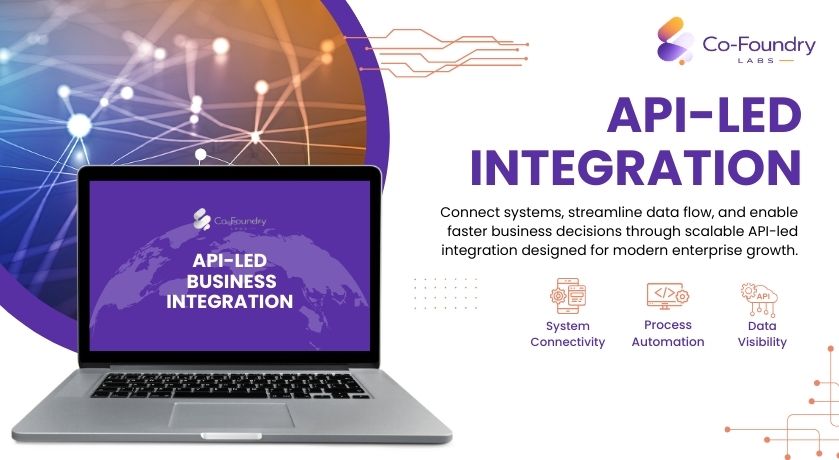
MuleSoft uses API-led integration to connect enterprise systems in a scalable and secure way.
Businesses use MuleSoft to:
- Connect Salesforce with ERP platforms
- Integrate finance systems
- Synchronize customer records across applications
- Support secure API access for business partners
- Enable real-time data exchange
Instead of building isolated integrations, MuleSoft creates reusable APIs that simplify future expansion.
This makes enterprise connectivity more sustainable and scalable.
Workato Accelerates Workflow Automation Across Business Teams
While MuleSoft focuses strongly on enterprise integration architecture, Workato adds another powerful layer through business-friendly workflow automation.
Workato helps organizations automate repetitive processes across cloud applications without heavy development effort.
Businesses use Workato to:
- Automate approval workflows
- Connect SaaS applications quickly
- Trigger actions across departments
- Reduce manual handoffs
- Improve operational speed
For example, when a customer record is updated in Salesforce, Workato can automatically trigger notifications, update collaboration tools, or initiate downstream approvals.
This creates faster operational movement across teams.
Workato is especially valuable when businesses need rapid automation between commonly used cloud platforms.
AI Adds Intelligence to Connected Systems
Once systems are connected through MuleSoft and workflows are automated through Workato, AI adds intelligence to business operations.
AI helps businesses move from connected systems to predictive and intelligent action.
AI supports:
- Lead prioritization
- Customer behavior prediction
- Service recommendations
- Automated decision support
- Forecasting and trend analysis
Because AI relies on data quality, its performance improves significantly when data flows consistently across platforms.
For example:
AI can analyze Salesforce customer activity, integration data flowing through MuleSoft, and workflow events triggered through Workato to recommend next-best actions for sales or service teams.
This creates a much smarter operating environment.
How These Four Technologies Work Together
The strongest connected enterprise architecture emerges when each platform plays a clear role.
Salesforce provides
Customer engagement and CRM visibility
MuleSoft provides
Secure enterprise integration through APIs
Workato provides
Workflow automation across cloud applications
AI provides
Decision intelligence and predictive capability
Together, businesses can achieve:
- Automated lead assignment across systems
- Real-time service escalation workflows
- Unified customer reporting
- Intelligent approval routing
- Faster operational response
Each platform strengthens the value of the others.
Business Benefits of Combining Salesforce, MuleSoft, Workato, and AI
Organizations that successfully align these technologies often achieve:
Better customer experience
Teams respond faster with connected information.
Reduced manual work
Automation removes repetitive tasks.
Improved reporting
Leadership sees consistent business data.
Faster decisions
AI-driven recommendations improve response time.
Scalable digital growth
Systems expand without increasing complexity.
Where Businesses Often Struggle
Technology investments often underperform when businesses:
- Implement CRM without integration planning
- Build automation without long-term architecture
- Use AI without connected data
- Ignore user adoption
A connected enterprise succeeds when technology decisions support both business needs and future scalability.
How Co-Foundry Labs Helps Build Connected Enterprise Solutions
At Co-Foundry Labs, enterprise transformation is approached through practical digital architecture that connects systems, workflows, and intelligence.
Co-Foundry Labs helps organizations:
- Implement Salesforce for customer-centric operations
- Design MuleSoft integration frameworks
- Introduce Workato automation for operational speed
- Apply AI capabilities that improve decision-making
By bringing these technologies together, Co-Foundry Labs supports businesses in building digital ecosystems that are scalable, connected, and aligned to measurable outcomes.
As enterprise systems continue to evolve, businesses that integrate CRM, APIs, automation, and intelligence will be better positioned to adapt and grow.
FAQs
1. How do Salesforce, MuleSoft, Workato, and AI work together?
Salesforce manages customer relationships, MuleSoft connects enterprise systems, Workato automates workflows, and AI adds predictive intelligence.
2. Why use Workato along with MuleSoft?
MuleSoft supports enterprise API architecture, while Workato enables faster workflow automation across cloud applications.
3. Can Workato integrate with Salesforce?
Yes, Workato supports Salesforce integrations for approvals, notifications, updates, and business process automation.
4. Is AI effective without connected systems?
AI performs best when data from multiple systems is connected and consistently available.
5. How does Co-Foundry Labs support connected enterprise transformation?
Co-Foundry Labs helps businesses align CRM, integration, automation, and AI into scalable digital solutions.