






Modern businesses depend on multiple digital systems to manage operations, customer engagement, finance, reporting, and internal collaboration. A single organization may use a CRM platform, ERP software, e-commerce applications, support tools, marketing platforms, and cloud databases—all at the same time.
While each system plays a valuable role, the real challenge begins when these platforms need to work together.
Disconnected systems create delays, duplicate data, inconsistent reporting, and operational inefficiencies. Teams spend time manually moving information between platforms, business decisions are made using incomplete data, and customers often experience inconsistent service.
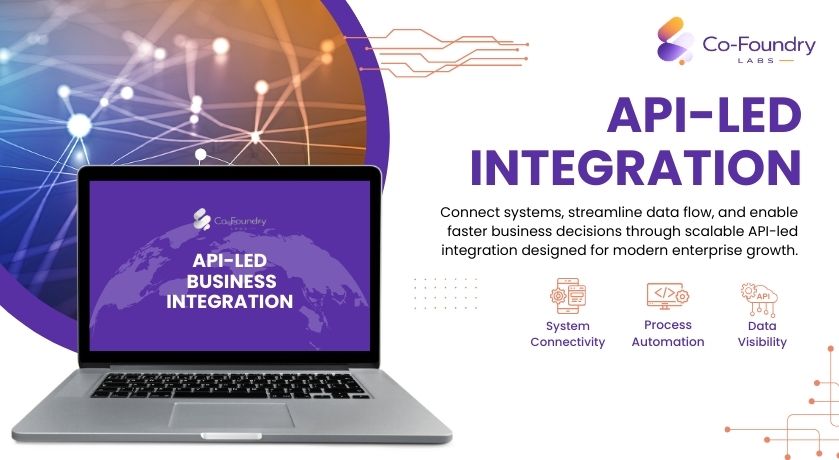
This is why API-led integration has become one of the most important foundations of modern digital transformation.
Businesses that want to scale efficiently are increasingly investing in integration strategies that allow systems to communicate securely, consistently, and in real time.
What Is API-Led Integration?
API-led integration is an approach where applications connect through Application Programming Interfaces (APIs) instead of relying on isolated point-to-point integrations.
An API acts as a structured way for systems to exchange information.
Instead of creating one custom connection for every system pair, businesses create reusable APIs that can serve multiple applications.
This creates a more organized integration architecture.
For example:
A customer update entered in a CRM platform can instantly trigger changes in billing systems, support applications, and reporting dashboards through APIs.
Without API-led integration, this often requires manual intervention or fragmented custom development.
Why Traditional Integrations No Longer Scale
Many businesses start with simple system connections built to solve immediate needs.
For example:
- CRM connected to finance software
- Website connected to order management
- Marketing platform connected to email tools
At first, this works.
But as systems increase, complexity grows rapidly.
Point-to-point integrations often lead to:
- High maintenance costs
- Difficult troubleshooting
- Limited scalability
- Data inconsistency
- Slower change management
Every new system adds more dependency.
Eventually, businesses reach a point where adding new applications becomes slow and risky.
API-led integration solves this by creating reusable integration layers.
The Three Layers of API-Led Integration
A strong API-led strategy often includes three levels of connectivity.
System APIs
These connect directly to core systems such as ERP, CRM, databases, and finance applications.
They expose data in a secure and reusable way.
Process APIs
These combine and orchestrate data from multiple systems based on business logic.
For example, combining customer, billing, and order data into one process.
Experience APIs
These deliver data in ways specific to channels such as web applications, mobile apps, or partner portals.
This layered approach allows businesses to reuse APIs instead of rebuilding integrations repeatedly.
How API-Led Integration Supports Business Growth
Businesses often view integration as a technical requirement, but in reality, it directly affects growth.
Faster decision-making
When systems are connected, leadership gains access to accurate real-time information.
Better customer experience
Teams can respond faster when customer data is available across systems.
Reduced operational delays
Manual transfers and repeated data entry decrease significantly.
Easier expansion
New applications can connect faster using existing APIs.
Stronger innovation capability
Businesses can introduce new digital services without rebuilding infrastructure.
API-led integration allows organizations to grow without increasing complexity.
The Role of CRM in API-Led Integration
Customer relationship platforms such as Salesforce often sit at the center of enterprise operations.
Sales teams, service teams, and customer success teams all depend on CRM data.
But CRM alone cannot provide complete visibility unless connected to:
- Finance systems
- Inventory systems
- Support platforms
- External applications
When CRM data flows through APIs, businesses create a more complete view of customer operations.
This improves both internal efficiency and customer satisfaction.
Why MuleSoft Has Become Important in API-Led Integration
MuleSoft has become a widely adopted platform because it supports scalable API-led connectivity across enterprise environments.
Businesses use MuleSoft to:
- Create reusable APIs
- Connect legacy systems
- Integrate cloud platforms
- Manage security and governance
- Support enterprise-scale transformation
Rather than building isolated integrations, MuleSoft helps businesses create structured digital ecosystems.
For growing organizations, this creates long-term flexibility.
API-Led Integration and Automation
Integration becomes even more powerful when paired with workflow automation.
For example:
A sales approval in CRM can automatically trigger:
- Contract generation
- Internal notifications
- Finance updates
- Service onboarding
Platforms such as Workato help businesses automate these cross-system processes quickly.
This means API-led integration does not just connect systems—it enables action across systems.
API-Led Integration Supports AI Readiness
Artificial Intelligence depends heavily on clean, connected, and reliable data.
When systems remain isolated, AI models often fail to produce meaningful business value.
Connected APIs improve AI readiness because they provide:
- Consistent data access
- Unified business context
- Better event visibility
- Reliable operational history
AI works best when enterprise data moves freely and securely.
This is why many AI initiatives begin with integration maturity.
Common Business Challenges Without API Strategy
Organizations without a strong integration strategy often experience:
- Duplicate customer records
- Delayed reporting cycles
- Slow onboarding of new systems
- Higher dependency on manual operations
- Increased IT maintenance burden
These issues often appear small at first but become significant barriers as businesses grow.
What Businesses Should Consider Before Starting API-Led Integration
A successful integration strategy begins with clear priorities.
Businesses should identify:
Which systems matter most
Focus on platforms that directly affect operations.
Which processes are slowest
Integration should remove friction where business impact is highest.
Which data needs consistency
Customer, finance, and operational data usually require priority.
Which future systems may be added
Scalability should be planned early.
API strategy works best when business goals guide technical decisions.
How Co-Foundry Labs Helps Businesses Build Connected Integration Strategies
At Co-Foundry Labs, integration is approached as a business growth enabler—not just a technical exercise.
Co-Foundry Labs helps organizations:
- Design scalable API strategies
- Connect CRM and enterprise platforms
- Implement MuleSoft-based integration architecture
- Introduce automation across business workflows
- Prepare digital ecosystems for AI readiness
By aligning integration with operational priorities, Co-Foundry Labs helps businesses build digital foundations that support long-term growth.
As organizations continue adopting more platforms, API-led integration will remain essential for maintaining agility, consistency, and competitive advantage.
FAQs
1. What is API-led integration?
API-led integration is a structured way of connecting systems through reusable APIs rather than isolated direct connections.
2. Why is API-led integration important for business growth?
It improves scalability, reduces manual work, and supports faster system connectivity.
3. How does MuleSoft support API-led integration?
MuleSoft helps businesses build reusable APIs and manage enterprise connectivity securely.
4. Can API-led integration improve customer experience?
Yes, connected systems help teams respond faster and work with consistent customer information.
5. How does Co-Foundry Labs support integration projects?
Co-Foundry Labs helps businesses design scalable API-led integration strategies aligned with digital growth goals.